Open-Top vs Enclosed Automatic Litter Boxes
Compare open-top and enclosed automatic litter boxes by entry, turning room, scatter, odor, safety systems, cleaning access, and cat acceptance.

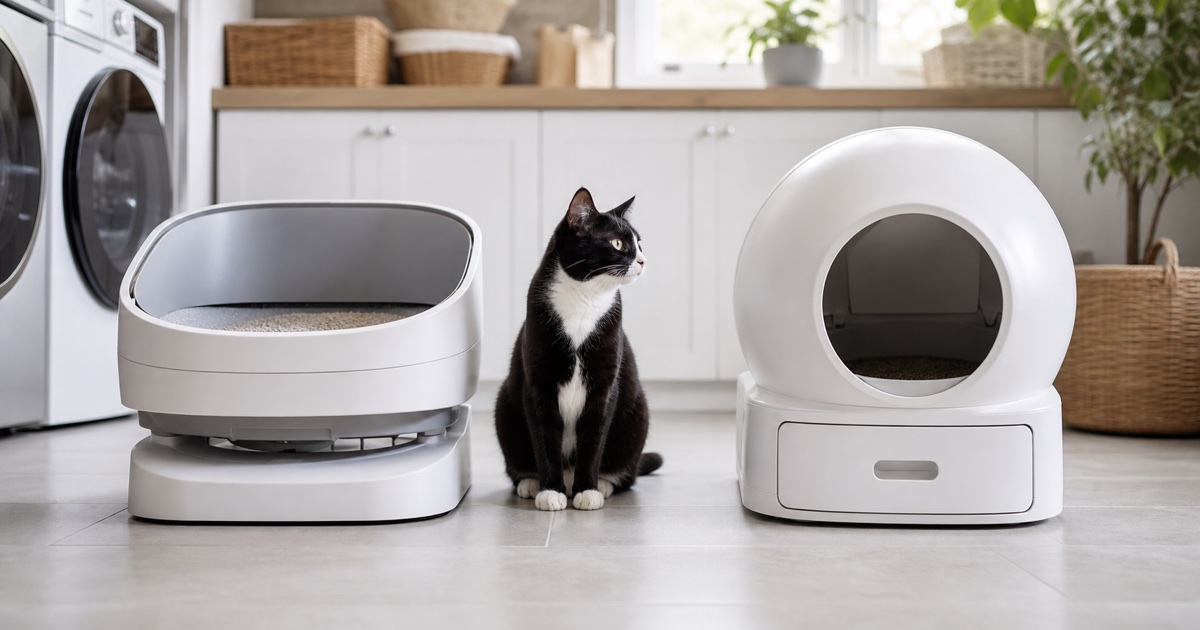
This guide explains decision criteria and does not claim hands-on product testing.
On this pageBrowse sections
The short answer
Choose an open-top automatic litter box when roof-free turning space and clear sight lines are the main constraints. Choose an enclosed automatic litter box when the cat already accepts covered entries and the household values a contained litter bed and sealed-drawer design.
Neither structure is universally better. The relevant question is which combination of entry, usable bed, moving parts, service access, and return protection fits one cat and one room.
This guide discusses only automatic and self-cleaning systems. For ordinary pans without motors, use our separate open versus covered litter box guide.
The structural differences
| Decision factor | Open-top automatic | Enclosed automatic |
|---|---|---|
| Turning | No fixed roof over the litter bed | Cat turns inside a globe or chamber |
| Sight lines | More open view of the room | View limited by doorway and shell |
| Entry | Can still be high | May use a step, ramp, or lower threshold |
| Scatter | More exposed bed and edge | Shell may contain some kicked litter |
| Odor | Waste system matters more than the open roof | Sealed drawer and filter may contain odor |
| Cleaning | Bed can be easier to reach | Globe, bonnet, seals, and sensors add surfaces |
| Room use | Wide exposed top must remain clear | Tall shell needs vertical service space |
Open-top automatic litter boxes
Neakasa M1 Plus represents the current rotating open-top format. The manufacturer publishes guidance from 2.2 to about 33 pounds and positions the open bed for large breeds. Its 13.86-inch entry is still high, however, and the US version was marked sold out during our research.
Open top removes one constraint—the roof—but not all constraints. Measure the litter bed, threshold, moving perimeter, waste system, and optional step. A long-bodied cat may turn more naturally without a globe, while a cat with a limited step-up may still struggle to enter.
The format can expose more litter to view and scatter. Its broad opening also needs to remain unobstructed during refilling and cleaning. See our large-cat automatic litter box shortlist for geometry-specific comparisons.
Enclosed automatic litter boxes
Litter-Robot 4 represents a rotating enclosed globe with a sealed waste drawer. Whisker publishes a 15.75-inch-square entry and a 19-by-18-inch interior, with interior height changing from 15 to 17 inches depending on litter level.
The shell can contain part of the litter bed and provides a defined waste path, but the cat must enter and turn inside a curved chamber. A large doorway does not prove comfortable interior posture. Enclosed models also add bonnet, globe, filter, seal, and sensor surfaces to the cleaning routine.
Buyers choosing between close enclosed systems should use the Litter-Robot 4 vs PETKIT PUROBOT MAX 3 comparison rather than infer quality from enclosure alone.
Safety depends on the system, not the roof
Do not treat an open top as automatically safe or an enclosure as automatically risky. Read how each unit detects entry, weight, motion, obstruction, and a cat approaching during rotation. Confirm the minimum cat weight for automatic mode and whether the opening remains available if power fails or a cycle stops.
Whisker says Litter-Robot 4 uses laser and weight sensors and stops a cycle when a cat enters a monitored zone. Neakasa publishes six sets of infrared sensors for M1 Plus. These are manufacturer descriptions, not our safety tests or guarantees.
Keep a conventional box available whenever a cat falls outside the model’s automatic-use guidance. Our Senior Cats automatic litter box guide gives entry and approach priority without making medical claims.
Match the room and maintenance path
Open-top systems need overhead access for pouring and washing. Enclosed systems need room to remove the drawer, bonnet, and globe. Both need a firm placement surface, power, an unobstructed approach, and clearance from walls as specified by the manufacturer.
For a studio or narrow laundry nook, compare the small-apartment automatic litter boxes by working clearance—not marketing footprint.
Transition without testing two changes at once
If possible, keep the familiar litter while introducing the new box structure. Changing the box, litter texture, location, and cleaning sound on the same day makes rejection difficult to diagnose.
Place the old box nearby, leave the automatic system off at first when instructed, and wait for repeated voluntary use before enabling the normal cycle. Follow the complete automatic litter box transition guide.
Bottom line
Open top is most useful when the roof and sight lines are the likely barriers. Enclosed is most useful when the cat already accepts a doorway and the household wants a contained bed and sealed waste path. Compare the actual entry, litter bed, sensors, service access, trial, and current availability before choosing the shape.
Evidence trail
Sources reviewed
These sources support the factual and safety context on this page. Product fit still depends on the individual cat, household, and current manufacturer instructions.
- Neakasa M1 Plus Open Top Self-Cleaning Cat Litter Box ↗Neakasa
Used as a current open-top example for entry, capacity, weight guidance, sensors, cleaning access, price, and availability.
- Litter-Robot 4 product specifications ↗Whisker
Used as a current enclosed example for dimensions, entry, sealed drawer, sensors, price, and trial terms.
- Litter box preference in domestic cats: covered versus uncovered ↗Journal of Feline Medicine and Surgery
Used to avoid claiming a universal group preference; the study tested conventional covered and uncovered boxes, not automatic models.
Frequently asked questions
Are open-top automatic litter boxes better for large cats?+
They can remove the roof as a turning constraint, but entry height, litter-bed size, moving geometry, weight guidance, and current availability still matter. Open-top does not automatically mean low-entry or roomy.
Do enclosed automatic litter boxes control odor better?+
A sealed waste drawer and enclosure can contain odor, but design, liners, filters, cleaning frequency, litter, humidity, and waste volume all affect the result. Without comparable real-home testing, enclosure alone does not prove better odor control.