Litter-Robot 4 Dimensions and Space Required
Measure for Litter-Robot 4 using its exact body, entry, globe, drawer, floor, outlet, wall, ramp, and cleaning-clearance requirements.
This guide explains decision criteria and does not claim hands-on product testing.
On this pageBrowse sections
Exact Litter-Robot 4 dimensions
Litter-Robot 4 measures 22 inches wide, 27 inches deep, and 29.5 inches high. Its rectangular body footprint is 594 square inches, or about 4.1 square feet. That number tells you whether the shell fits; it does not tell you whether the appliance can be used and cleaned in the space.
| Measurement | Published size | Why it matters |
|---|---|---|
| Exterior | 22 W × 27 D × 29.5 H inches | Minimum body slot |
| Entry | 15.75 × 15.75 inches | Approach and cat fit |
| Inside globe | 19 W × 18 D × 15–17 H inches | Turning space changes with litter level |
| Litter bed | Up to 14 inches wide | Usable bed is narrower than the shell |
| Waste drawer | 13.5 W × 9.25 D × 5.5 H inches | Needs a straight removal path |
| Empty weight | 24 pounds | Moving it becomes harder after adding litter |
If cat fit is the concern rather than room fit, use the separate automatic litter box guide for large cats.
Body footprint versus working space
Do not measure a 22-by-27-inch rectangle and stop. Whisker instructs owners to use a cool, dry location near power, on a firm level surface, without pushing the unit against a wall or into a corner.
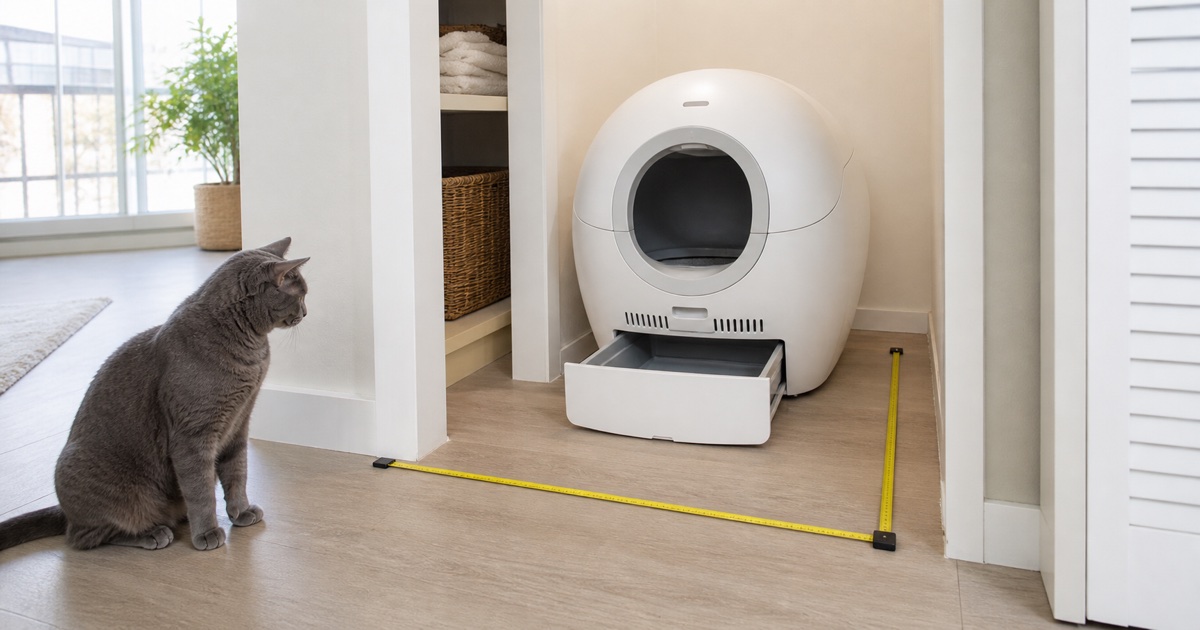
For initial planning, PetGearWise suggests checking a 30-inch-wide by 48-inch-deep open zone. This is an editorial planning envelope, not a Whisker requirement. It leaves side tolerance around the 22-inch body and roughly 21 inches in front for the drawer, mat, kneeling access, and approach path.
Test the zone with painter’s tape. Then stand where you would empty the drawer and lift the globe. If a door, laundry basket, shelf, or walkway blocks that motion, the body technically fits but the routine does not.
Floor, wall, and outlet requirements
Use a firm, level floor for the most accurate weight readings. Whisker says carpet thicker than 3 mm or uneven flooring can reduce SmartScale accuracy and recommends its Carpet Tray in that situation.
Check four placement details:
- The rear cord reaches an outlet without running under the scale feet.
- The shell is not pressed against a wall or wedged into a corner.
- The entry and front drawer face open space.
- A litter mat does not sit under the base and change its level.
A bathroom may provide wipeable flooring but adds humidity and narrow door swings. A laundry room may provide space but creates noise and traffic. Choose the location where the cat has reliable access and the owner can maintain the machine—not the location that hides it best.
Drawer and cleaning clearance
The waste drawer pulls from the front. Leave enough straight-line clearance to remove it without turning the machine. You also need to open the bonnet, lift out the globe, carry washable parts to a cleaning area, and reach the base without spraying electronics.
Low shelves can interfere even when the 29.5-inch shell clears them. Do a dry run with a box or chair at the planned height: can you lift a bulky round component without scraping the shelf or twisting over the appliance?
The Litter-Robot 4 cleaning schedule explains why service access is part of the footprint rather than an occasional exception.
Add the ramp, mat, and old box
An optional ramp starts at $65 and extends the approach beyond the published 27-inch body depth. Whisker does not publish the installed ramp projection on the product page we reviewed, so do not guess from a photo. Install or obtain the current accessory dimensions, then remeasure the full path.
During transition, the old box should remain nearby. That means the temporary setup needs two boxes, not one. If the room only fits Litter-Robot 4 after removing the familiar pan, it may be too tight for a low-pressure transition.
For smaller rooms, compare models using the small-apartment automatic litter box shortlist, which ranks cleaning access and drawer travel separately from exterior footprint.
A five-minute measurement checklist
- Tape a 22-by-27-inch body rectangle on the floor.
- Expand the test zone to 30 by 48 inches for working access.
- Confirm 29.5 inches of body height plus open lifting space.
- Open nearby doors and drawers to expose conflicts.
- Trace the power cord without crossing the scale feet or walkway.
- Reserve room for a mat, optional ramp, and transition box.
- Verify the cat can approach without being cornered by another pet.
Bottom line
Litter-Robot 4 occupies about 4.1 square feet at the base, but a usable installation needs more. Plan around the front service path, level floor, wall separation, power, vertical cleaning access, and temporary second box. If those requirements feel awkward on tape, they will feel worse when the drawer is full.
Evidence trail
Sources reviewed
These sources support the factual and safety context on this page. Product fit still depends on the individual cat, household, and current manufacturer instructions.
- Litter-Robot 4 product specifications ↗Whisker
Used for current exterior footprint, height, entry size, included step, price, and carpet guidance.
- Getting started with Litter-Robot 4 ↗Whisker Support
Used for firm-level-floor, power-outlet, wall, corner, transition, drawer, and cleaning placement instructions.
- Litter-Robot 4 frequently asked questions ↗Whisker Support
Used for interior globe and waste-drawer dimensions and litter compatibility.
Frequently asked questions
How much floor space does Litter-Robot 4 use?+
Its published body footprint is 22 by 27 inches, or about 4.1 square feet. That is not the full working area because the owner still needs front access, wall separation, a power route, and room for any mat or ramp.
Can Litter-Robot 4 go in a closet?+
Only if the closet remains cool and dry, the unit is not pushed against a wall or into a corner, the entry stays open, and you can fully service the drawer and remove components. A tightly fitted closet is usually a poor maintenance location.