How Often Should You Clean a Litter-Robot 4?
Use a practical Litter-Robot 4 cleaning schedule for the drawer, visible residue, sensors, globe, filter, deep cleaning, and multi-cat adjustments.

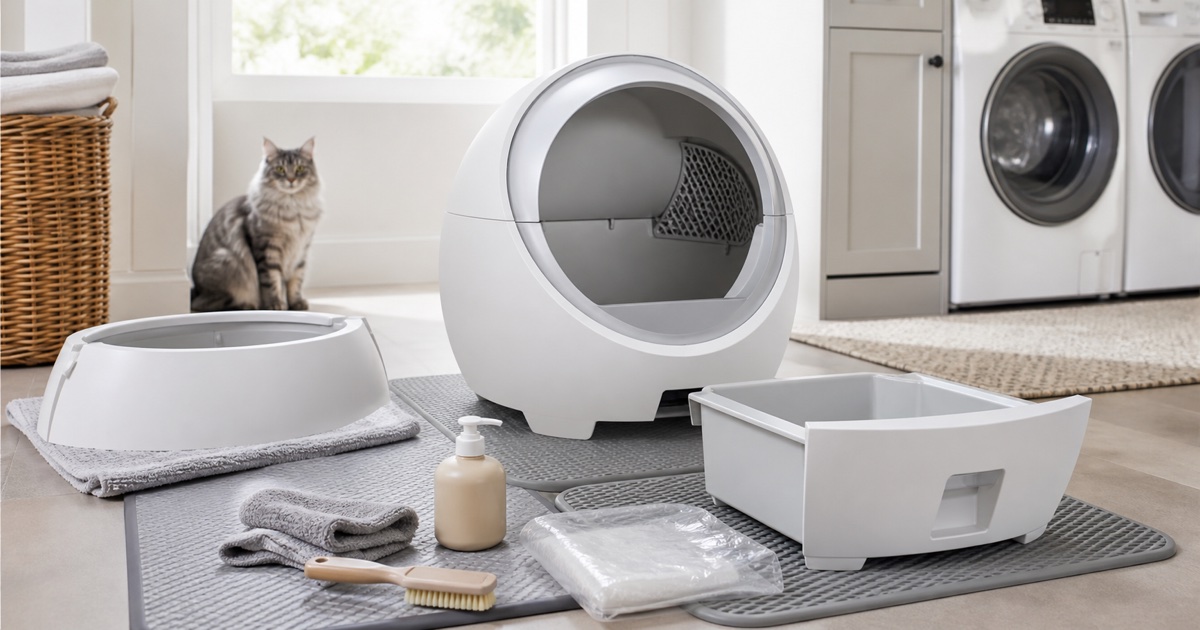
This guide explains decision criteria and does not claim hands-on product testing.
On this pageBrowse sections
The practical schedule
For most homes, use four maintenance layers instead of one vague “deep clean” date:
| Task | Starting schedule | Adjust when |
|---|---|---|
| Check drawer, litter, and visible residue | Daily glance | App alert, odor, smearing, low litter, or interrupted cycle |
| Empty and reline drawer | About weekly for one cat | Drawer level, cat size, waste volume, heat, or humidity requires earlier action |
| Basic globe clean | Every 1–3 months | Residue or errors appear sooner |
| Deep clean | At least every 3 months | Multi-cat use or buildup calls for a shorter interval |
These are starting points, not a promise that the machine stays clean until a calendar date. Automatic sifting moves clumps out of the litter bed; it does not wash the globe, sensors, drawer, seals, or exterior.
Daily and weekly checks
Take a few seconds each day to confirm the globe is home, the light bar is normal, the entry is clear, litter is near but not above the fill line, and no residue needs prompt removal. A self-cleaning cycle can hide waste in the drawer, so the absence of visible clumps is not proof that the system needs no attention.
Whisker’s current getting-started guide says a single-cat household will usually empty the drawer about once per week; two average-size cats may need twice-weekly emptying. Empty it when the app or flashing blue light indicates full rather than waiting for the longest estimate.
Flatten the new liner against the drawer. Puffy, stretched, or dark bags can affect waste-level readings. Whisker allows compatible clear 8–13 gallon bags, so custom liners are convenient rather than mandatory.
Basic globe cleaning every one to three months
Whisker recommends a basic globe cleaning every one to three months. Shorten that interval when clumps stick, residue reaches the liner or waste port, odor remains after drawer service, or a multi-cat household cycles frequently.
Before cleaning, follow the current empty-cycle instructions, power off, unplug, and remove components in the documented order. Use mild soap and water or a current manufacturer-approved cleaner on the globe. Dry it completely before adding litter because remaining water can turn clay into paste and interfere with movement.
Litter choice can change how quickly residue develops. The best litter for Litter-Robot 4 guide prioritizes explicit sifting compatibility, but no research-only shortlist can predict smearing in your household.
Deep-clean at least every three months
A deep clean adds the drawer, bonnet, seals, waste port, exterior, and accessible base surfaces to the globe wash. Whisker says to do this at least every three months and more often as use requires.
The critical boundary is water: never submerge, spray, or soak the base or control panel. Spray cleaner on a cloth away from the electronics, then wipe. Do not reinstall damp components. Inspect the seal strips without soaking them, and check that the globe gear track and rear bearing position correctly during reassembly.
After moving, cleaning, adding litter, or emptying the drawer, use the Reset control as directed so the weight scale can establish a new baseline.
Clean sensors when debris or errors appear
The three curtain sensors sit at the top of the bezel. Dust and fur can affect cat detection, litter level, and waste readings. Whisker’s sensor guide instructs owners to wipe the bezel and sensor area with a dry clean cloth; its detailed guidance also allows careful vacuuming with a brush attachment.
Do not improvise liquids, compressed-air pressure, cotton swabs, or disassembly around sensors unless the current support instructions specify them. If light codes continue after the documented clean and reset, use Whisker support instead of repeatedly cycling an unreliable unit.
Filter and litter are separate schedules
Whisker says the carbon filter lasts about one month under normal use and is not required for operation. The product page recommends replacing carbon filters or OdorTrap packs every two to four weeks for optimal odor absorption, while also saying frequency depends on household use.
Check litter each time you empty the drawer and top up only to the marked line. Do not replace the entire bed on a fixed weekly schedule unless contamination or the litter manufacturer’s instructions require it.
For ongoing branded accessory arithmetic, see whether Litter-Robot 4 is worth it for one cat. The broader Litter-Robot 4 review covers the ownership trade beyond cleaning.
Make the schedule fit your household
Move tasks earlier when you have several cats, a cat that does not consistently cover waste, soft residue, high humidity, a rapidly filling drawer, recurring odor, or sensor errors. Do not delay cleaning just because the app shows remaining drawer capacity.
Keep a conventional box available while washable components dry or the unit is unplugged. That backup is especially useful when a deep clean takes longer than expected.
Bottom line
Start with a daily glance, roughly weekly drawer service for one cat, globe cleaning every one to three months, and a deep clean at least every three months. Let visible condition, use volume, and support alerts shorten the schedule. Automation removes scooping events; it does not remove inspection or washing.
Evidence trail
Sources reviewed
These sources support the factual and safety context on this page. Product fit still depends on the individual cat, household, and current manufacturer instructions.
- Litter-Robot 4 use and care ↗Whisker Support
Used for basic globe, deep-clean, filter, liner, water, and multi-cat frequency guidance.
- Getting started with Litter-Robot 4 ↗Whisker Support
Used for typical one-cat and two-cat drawer schedules, litter checks, placement, and reset workflow.
- Litter-Robot 4 deep cleaning guide ↗Whisker Support
Used for safe disassembly, globe washing, base wiping, complete drying, and reassembly steps.
- Litter-Robot 4 laser sensor cleaning ↗Whisker Support
Used for dry bezel and curtain-sensor cleaning guidance.
Frequently asked questions
How often should I deep-clean Litter-Robot 4?+
Whisker recommends a basic globe cleaning every one to three months and a deep cleaning at least every three months. More cats, residue, humid conditions, or recurring errors can justify shorter intervals.
Can I hose down the Litter-Robot 4 base?+
No. The base and control panel contain sensors and electronics and should never be submerged, sprayed, or soaked. Apply the current approved cleaner to a cloth, not directly to the base.