How to Plan a Cat Climbing Wall That Works Both Ways
Plan a cat climbing wall by mapping entry, landings, rest, exit, wall structure, and multi-cat traffic before buying or drilling. Includes a practical layout checklist.
This guide explains decision criteria and does not claim hands-on product testing.
On this pageBrowse sections
Start with a route, not a shopping cart
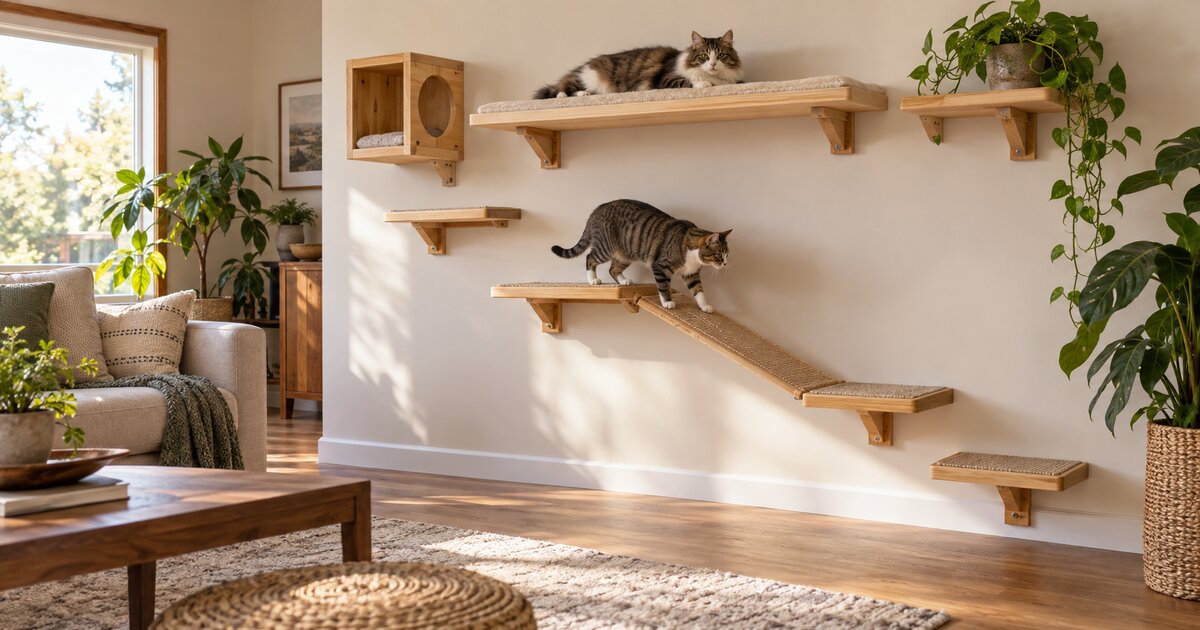
A cat climbing wall is a small circulation system. It needs a way in, intermediate landings, a reason to pause, and a way out. If one of those is missing, more shelves may only make an expensive dead end.
Draw the path before choosing a kit. Follow it from the floor to the highest perch and back to the floor. Then imagine the same route while another cat is sitting in the most desirable spot. This two-direction test reveals problems that a product-count checklist misses.
Step 1: Watch the cat and choose the destination
For a few days, note where the cat already pauses, watches people, looks out a secure window, or retreats. Put the destination in a room the cat uses, rather than treating an empty wall as the reason to build. The Feline Veterinary Medical Association describes elevated choices and hiding places as important parts of the indoor environment.
Use a different route for a cat that loves climbing a sisal post than for one that prefers broad, low steps. A kitten, senior cat, or cat with a mobility concern may need an easier path. If movement has changed recently, ask a veterinarian; furniture layout is not a diagnosis.
Step 2: Draw four jobs on the wall
| Route job | What to draw | Common failure |
|---|---|---|
| Entry | A low starting platform or stable furniture connection | First move requires a leap from bare floor to a high shelf |
| Transit | Landings with grip and enough room to aim the next move | A narrow peg works for ascent but not turning or descent |
| Rest | A broad perch where the cat can stop without blocking all traffic | Only comfortable bed is at a dead end |
| Exit | A second downward sequence or a clear return along the same route | Cat reaches a high point and must jump to the floor |
For multi-cat homes, add a passing or bypass point near the favorite rest area. This is a design inference from the need to let cats access resources without being cornered. It is not a guarantee that cats will share a wall peacefully.
Step 3: Test the moves before drilling
Use painter’s tape to outline each proposed platform. Check the actual usable surface, not the outside measurement in a photo. Does the cat have room to land, turn, and choose its next step? Where will the tail and body go when it changes direction?
Catastrophic Creations suggests roughly 12–18 inches of vertical spacing for its furniture and cats without mobility issues. Treat that as a manufacturer example, then compare it with your cat’s comfortable movements on existing stable furniture. Shorten gaps or use ramps when the cat needs them; the Feline Veterinary Medical Association recommends steps or ramps to favorite perches for cats with chronic pain or limited mobility.
Trace the descent separately. A cat that jumps up easily may dislike jumping down onto a narrow surface. If the route ends above hard flooring, stairs, fragile objects, or a doorway, choose a different destination.
Step 4: Let the wall structure set the layout
Mark the maker-approved attachment points before deciding where each piece goes. On framed drywall, a product designed for studs must reach suitable framing; drywall alone is not the attachment plan. Brick, concrete, and metal studs can require different hardware and instructions. Catastrophic Creations provides separate guidance for those surfaces and warns against drywall anchors as the primary support for its products.
This is where a beautiful sketch may need to change. Move a perch to a sound mounting point, choose a compatible shelf span, or use a different wall. Never make the fastener choice from a generic weight rating alone. Check for hidden electrical and plumbing lines and have an installer assess unfamiliar wall construction.
If a wall installation is appropriate, compare complete cat climbing wall systems for stud span and route shape. For one broad landing, see wall-mounted shelves for large cats. If mounting is not possible, consider no-wall-drill tension trees only where the ceiling meets the manufacturer’s requirements.
Step 5: Make the route maintainable
Leave access to tighten, clean, and replace parts. A high fabric bed that cannot be removed for washing is a different commitment from a wipeable shelf. Keep climbing paths away from stoves, breakable displays, dangling cords, unsecured windows, and routes over open stairs.
After installation, inspect the furniture according to the maker’s schedule and whenever a piece moves, creaks, tilts, or wears. Watch the cat use the route in both directions. If it routinely skips a platform, stalls at a gap, or jumps directly to the floor, revise the path instead of assuming it will learn the intended sequence.
A five-minute pre-purchase check
- Can I name the cat’s entry, rest point, and exit without pointing to a risky jump?
- Is each landing large enough for this cat to turn and descend?
- Can another cat pass or retreat near the favorite perch?
- Do the actual wall materials and attachment points match the product’s instructions?
- Can I inspect, clean, and replace the pieces after installation?
If any answer is uncertain, measure or simplify the route first. For the underlying behavior question, read what cats can and cannot climb on a wall.
The best cat wall is not the tallest layout. It is the shortest complete route that gives the cat a useful destination and a comfortable way home.
Evidence trail
Sources reviewed
These sources support the factual and safety context on this page. Product fit still depends on the individual cat, household, and current manufacturer instructions.
- Setting Up the Environment for Success ↗Feline Veterinary Medical Association
Used for indoor vertical space, hiding choices, and matching resources to the cat.
- 2024 AAFP Intercat Tension Guidelines ↗Feline Veterinary Medical Association
Used for the need to consider tension and access to resources in multi-cat homes.
- How to Install Cat Shelves & Wall-Mounted Cat Furniture ↗Catastrophic Creations
Used for the maker's stud and masonry installation requirements and pre-installation wall planning.
- Furniture for Cats: Frequently Asked Questions ↗Catastrophic Creations
Used for example spacing and the warning against drywall anchors as primary support for that manufacturer's products.
- Patient Support: Chronic Pain Toolkit ↗Feline Veterinary Medical Association
Used for considering steps and ramps to favorite places when mobility is limited.
Frequently asked questions
How far apart should cat wall shelves be?+
There is no distance that fits every cat. Catastrophic Creations suggests roughly 12–18 inches vertically for healthy mobile cats using its furniture, but test a route against your cat's comfortable movements and shorten or ramp transitions when needed.
Does a cat climbing wall need two exits?+
A second way off a high-value perch is especially useful when more than one cat uses the wall. It reduces the chance that one cat can block the other at a dead end. A single-cat wall still needs a clear, comfortable way down.
Can renters make a cat climbing wall without drilling?+
A true wall-mounted system usually requires structural attachment. If the lease or wall does not allow that, choose a suitable freestanding cat tree or a manufacturer-approved tension system after checking ceiling compatibility. Do not substitute adhesive or drywall anchors for the product's required hardware.