Can Cats Climb Walls? What an Indoor Cat Wall Really Needs
Cats can climb grippy surfaces, but smooth indoor walls need a secure route. Learn what changes with brick, drywall, wall shelves, age, and multiple cats.

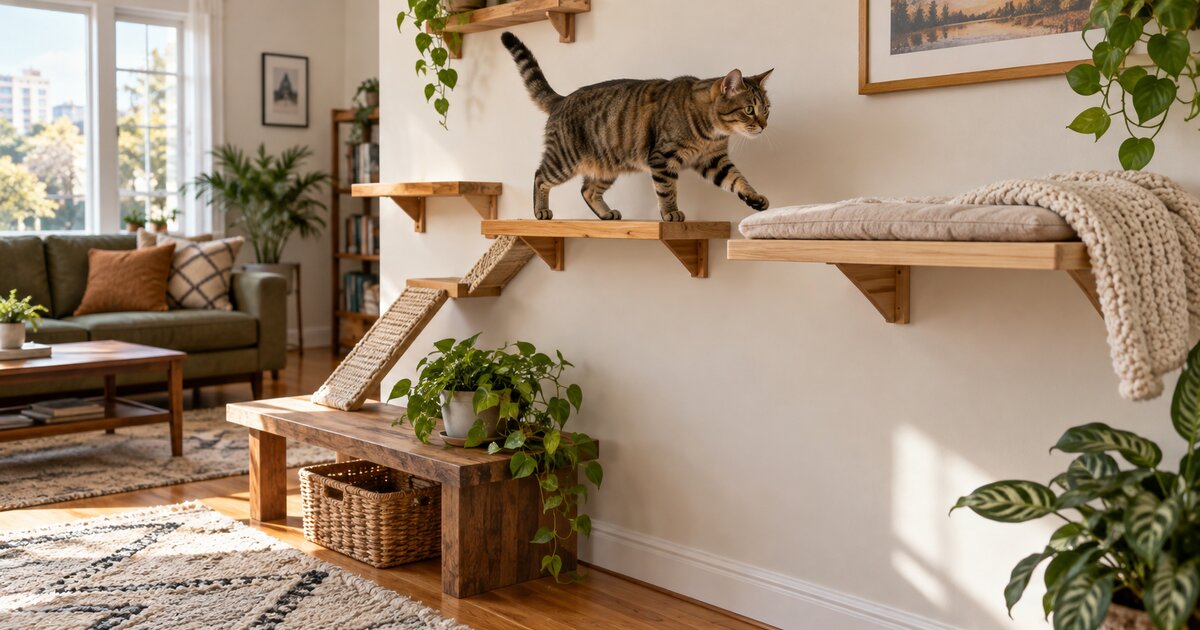
This guide explains decision criteria and does not claim hands-on product testing.
On this pageBrowse sections
The short answer
Cats can climb surfaces that give their claws purchase, and many can jump between elevated places. A smooth painted wall is different: it offers little grip. A “cat climbing wall” indoors is therefore a route made of shelves, steps, poles, ramps, or hammocks that are suitable for both the cat and the wall behind them.
The most useful question is not “How high can my cat get?” It is “Can this cat get up, turn around, rest, and come down without a risky leap?” That distinction matters more than the number of pieces in a product photo.
What the wall surface changes
| Surface | What a cat might do | What an owner still has to solve |
|---|---|---|
| Smooth painted drywall | Jump to nearby furniture; little direct claw grip | Structural mounting for shelves and a route down |
| Rough brick | Grip some texture, depending on the cat and wall | Crumbling material, exposed height, landing, and masonry-compatible mounting |
| Carpeted or sisal climbing panel | Grip the added material | Secure attachment, wear, and a usable landing at each end |
| A built wall-furniture route | Step, jump, scratch, and rest on separate pieces | Platform size, spacing, traffic between cats, and inspection |
These are possibilities, not a climbing test. Do not invite a cat to scale a bare wall to see what happens. A cat that can go up may still face a difficult descent.
The hidden problem is the return trip
Many attractive cat walls photograph well from the floor: a tall hammock, a few staggered steps, and an open patch of wall. The weak point is often the way back. A cat may reach the top by jumping from a sofa, then find the shelf too narrow to turn on or the drop too far to descend comfortably.
Before buying, trace the route in both directions with a finger. Mark an entry, each secure landing, a place to pause, and at least one comfortable exit. In a multi-cat home, imagine one cat occupying the favorite perch: can the other pass or retreat without being forced into a face-to-face encounter? The Feline Veterinary Medical Association emphasizes vertical choices and separate resources; a single shared dead end gives less choice than its height suggests.
Our cat climbing wall layout guide turns this into a room-by-room planning exercise. For a ready-made system, compare the wall-mounted climbing systems by route and stud span rather than appearance alone.
Can cats climb brick walls?
Some athletic cats can grip rough masonry, but brick is not uniformly rough or sound. Smooth sealed brick, loose mortar, and a long vertical face create different conditions. Climbing ability also changes with age, confidence, and mobility. A visible grip on the way up does not prove there is a safe route down.
If the question is about mounting furniture to brick, separate that from a cat climbing bare brick. Catastrophic Creations describes brick and concrete installation for its own systems and says its standard wood-wall hardware is not suitable for masonry. That guidance is product-specific, not a license to choose a generic anchor or drill into unknown masonry. Check the maker’s instructions and the wall; get qualified installation help when either is uncertain.
Drywall is a finish, not the whole structure
On a typical framed interior wall, the shelf attaches through drywall into suitable framing when the product requires it. Catastrophic Creations warns that drywall anchors alone did not hold reliably in its jumping-load tests. Another manufacturer’s instructions may differ, so use the requirements for the exact furniture you own.
Do not infer safety from a published weight rating alone. That number describes a product under specified conditions; it cannot verify the hidden wall, fasteners, workmanship, or repeated side loads from a jumping cat. Locate studs and check for electrical or plumbing hazards before any drilling. If the framing or material is unclear, stop the installation and consult a qualified installer.
For large cats, compare our wall-mounted shelves with published platform dimensions. Surface depth and the route into the shelf can matter as much as its stated load.
Match the climb to the least mobile cat
The maker’s example spacing of roughly 12–18 inches between levels applies to cats without mobility problems; it is not a universal safe distance. Watch what your cat already does comfortably on stable furniture. A cat that hesitates, lands awkwardly, or avoids a jump needs an easier route. The Feline Veterinary Medical Association recommends steps or ramps to favorite perches when mobility is limited.
If an older cat has stopped jumping or climbing as usual, treat that change as useful health information and ask a veterinarian about it. A lower perch, floor tree, or ramp may serve the cat better than a taller wall. Our cat-tree guide covers that alternative.
The wall’s job is not to prove a cat can climb. Its job is to give that particular cat a repeatable way to move, rest, and leave.
Evidence trail
Sources reviewed
These sources support the factual and safety context on this page. Product fit still depends on the individual cat, household, and current manufacturer instructions.
- Setting Up the Environment for Success ↗Feline Veterinary Medical Association
Used for the value of elevated choices, hiding places, and surfaces that fit individual cats.
- How to Install Cat Shelves & Wall-Mounted Cat Furniture ↗Catastrophic Creations
Used for manufacturer-specific guidance about studs, brick, concrete, and planning the wall before installation.
- Furniture for Cats: Frequently Asked Questions ↗Catastrophic Creations
Used for the maker's drywall-anchor warning and its example spacing for healthy, mobile cats.
- Patient Support: Chronic Pain Toolkit ↗Feline Veterinary Medical Association
Used for accessible ramps and steps when a cat has difficulty reaching favorite perches.
Frequently asked questions
Can cats climb a smooth painted wall?+
A smooth painted wall gives claws little to grip. Some cats can jump toward nearby furniture or use a corner, but a safe indoor route needs secure, usable climbing or stepping surfaces rather than an assumption that the wall itself is climbable.
Can cats climb brick walls?+
Some cats can grip rough brick or mortar, but ability varies with texture, height, age, and the route down. Rough brick is not a safety plan. If you mount cat furniture to masonry, follow that product's masonry instructions and check the wall's condition.
Can I attach a cat climbing wall to drywall alone?+
Do not assume drywall alone can support jumping loads. Catastrophic Creations specifically requires structural attachment for its products and warns against drywall anchors as the primary support. Follow the exact maker's instructions for your wall and ask a qualified installer if its construction is uncertain.