Best Treat-Dispensing Toys for Cats
Compare treat-dispensing toys for cats by release mechanism, food size, difficulty adjustment, cleanup, floor space, noise, and supervision needs.
PetGearWise may earn a commission from qualifying purchases after affiliate links are added. This guide currently links to manufacturer product information and receives no compensation for clicks. Read our affiliate disclosure.
Best match in this guide
Our top recommendation: PetSafe Egg-Cersizer
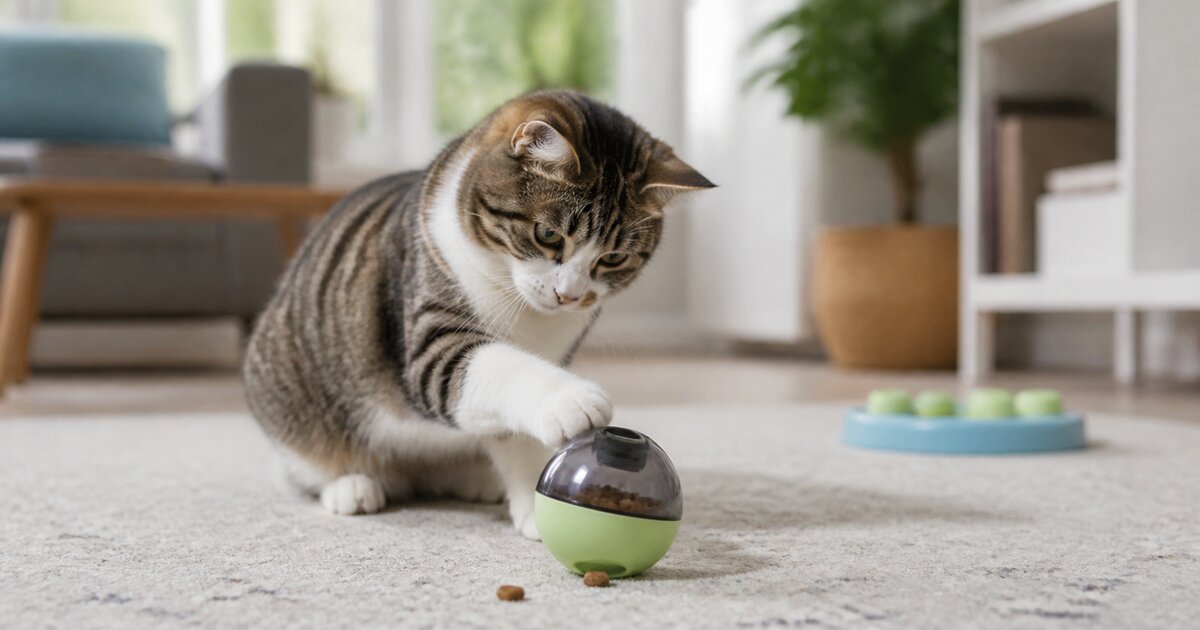
Egg-Cersizer is the clearest rolling-food choice because its one-, two-, or three-hole setup lets an owner begin with a generous release and reduce it gradually. PetSafe lists it for treats or dry food, with top-rack dishwasher cleaning and a 3-by-3.6-by-7.9-inch body. It needs a clear rolling lane, and loose pieces can travel under furniture if the room is not prepared.
- Best for
- Cats that will roll a toy across open floor space for a measured dry-food portion and need an easy first setting
- Buying note
- $9.95 on PetSafe's direct store when checked; verify current U.S. price, delivery, and retailer availability.
On this pageBrowse sections
Decision first
Quick picks
The short answer
Choose the PetSafe Egg-Cersizer when a cat will roll a toy across an open floor for a measured dry-food portion. The Catit PIXI Treat Dispenser is the quieter, compact alternative when self-righting batting makes more sense than a long chase. Choose the Catit Senses Food Tree to keep the food activity in one location, or the Catit PIXI Spinner when a paw-triggered moving toy is the real attraction.
A treat-dispensing toy is not simply a beginner puzzle with food inside. The deciding question is how the food comes out: by rolling, batting, pawing from a fixed station, or triggering movement. Choose that action before comparing a product’s shape or novelty features.
Compare the release formats
| Pick | How food is released | Best room fit | Main trade-off |
|---|---|---|---|
| PetSafe Egg-Cersizer | Cat rolls a dispensing body | Clear floor with limited under-furniture gaps | Pieces can travel |
| Catit PIXI Treat Dispenser | Cat bats a self-righting body | Small play area near a rug or mat | Small food-size limit |
| Catit Senses Food Tree | Cat paws food from a fixed tower | Homes that need a contained food station | More parts to clean |
| Catit PIXI Spinner | Paw-triggered spinning motion releases food | Supervised active-play area | Batteries and feather upkeep |
How we chose
We checked current manufacturer pages for food type and size, release mechanism, difficulty adjustment, cleaning instructions, power needs, replacement parts, and the conditions that make each format useful. We selected four distinct actions rather than filling a list with near-identical rolling balls.
This is a research-based comparison, not a test of treat flow, noise, durability, or how long an individual cat stays interested. Manufacturer food and portion guidance is not a medical feeding recommendation. Verify the current instructions and product availability before buying.
Choose the action before the difficulty
A rolling dispenser asks a cat to pursue food across the floor. It can make a dry-food portion more active, but it also needs a path away from vents, stairs, and furniture gaps. A self-righting toy keeps the action near one spot and is often easier to reset between short sessions.
A fixed paw feeder is better when the household needs the food to remain on a mat or in one room. It asks for reaching and problem-solving rather than chasing. A moving dispenser adds a different kind of stimulation, but batteries, noise, and detachable accessories become part of the decision.
If the main goal is a first easy success with a stationary puzzle, compare our beginner cat puzzle toys. That guide ranks learning difficulty; this one ranks the food-release action. For a wider rotation of climbing, chase, foraging, and rest, see the indoor cat enrichment guide.
Start with the normal food plan
Use only dry food or treats that the specific product allows. Measure the portion before filling the toy, begin with the easiest release setting, and put a few pieces where the cat can find them without solving a hard sequence. A toy should create a clear cause and reward, not turn every meal into a puzzle the cat cannot finish.
Do not add extra snacks simply because the toy has capacity. When a cat eats wet food, has a prescribed diet, or needs a feeding change for a health reason, do not improvise around the usual plan. Our slow-feeder guide for cats that eat too fast covers a different food-pace decision, including formats that do not roll across the room.
Keep food play contained and clean
Test a rolling format on the intended floor before making it part of a routine. Close the gap under a sofa if food can disappear there, use a low grippy mat when a plastic toy slides, and sweep up missed pieces before the next session. Empty and inspect every chamber or groove after use; old crumbs make a toy harder to clean and can change how reliably it releases food.
For powered options, examine the battery compartment, fabric, feathers, and attachment points before and after each session. Stop using any product that cracks, exposes a part, or makes the cat chew rather than forage. Treat dispensing is one activity in a rotation, not a substitute for responsive play or a complete feeding setup.
Do not use one food toy to manage two diets
One shared toy cannot decide which cat receives each piece. If cats compete, take turns with the toy in separate areas or choose another enrichment activity. For households that need to keep ordinary meals separate, use a selective-access feeder for cats on different diets rather than asking a toy to control access.
Remote treat cameras have the same limitation: they can launch food but cannot distribute it fairly. Compare treat-dispensing pet cameras for multiple cats only when remote viewing is the actual need.
The best treat toy does not release the most food. It creates one understandable action, keeps the portion deliberate, and fits the room you can supervise.
Research shortlist
The picks in detail
PetSafe Egg-Cersizer
Best for: Cats that will roll a toy across open floor space for a measured dry-food portion and need an easy first setting
Egg-Cersizer is the clearest rolling-food choice because its one-, two-, or three-hole setup lets an owner begin with a generous release and reduce it gradually. PetSafe lists it for treats or dry food, with top-rack dishwasher cleaning and a 3-by-3.6-by-7.9-inch body. It needs a clear rolling lane, and loose pieces can travel under furniture if the room is not prepared.
Why it stands out
- One, two, or three dispensing holes
- Can use measured dry food or treats
- Top-rack dishwasher safe
Watch-outs
- Needs open floor space to roll
- Dry pieces can escape under furniture
- Not for wet food or large irregular treats
Catit PIXI Treat Dispenser
Best for: Cats that prefer batting from one area and owners who want a compact, battery-free adjustable dispenser
The Catit PIXI Treat Dispenser uses a weighted, self-righting body rather than a long rolling path. Its slider changes the opening, and Catit specifies dry food or treats up to 9 millimeters in diameter with about 60 grams of capacity. That makes it a good lower-motion starting point, but the small opening still needs matching food pieces and regular crumb checks.
Why it stands out
- Self-righting weighted design
- Adjustable treat opening
- No batteries required
Watch-outs
- Accepts pieces only up to 9 mm
- Smaller capacity than a meal feeder
- Opening can collect crumbs
Catit Senses Food Tree
Best for: Cats that will reach and paw for dry food but are not interested in chasing a rolling object around the room
The Senses Food Tree keeps the food activity in one stable location. Catit publishes four levels, a collector tray, and three opening settings for dry food or treats, so it is the most deliberate choice when scattered rolling pieces would be inconvenient. Its layered construction brings more surfaces to empty and clean, and it does not create the chase element some cats need.
Why it stands out
- Stationary base keeps food activity contained
- Three published opening settings
- Collector tray catches dropped pieces
Watch-outs
- More parts and levels to clean
- Does not create a rolling chase
- Dry food and treats only
Catit PIXI Spinner
Best for: Cats that engage with a paw-triggered moving toy and owners willing to manage batteries, feathers, and supervised sessions
PIXI Spinner pairs a paw-triggered spinning feather with occasional food release, so it is a play-first option rather than a simple meal puzzle. Catit specifies treats or dry food up to 9 millimeters, automatic standby, and replaceable cover and feather parts. The added moving accessory and battery requirement create more upkeep than a passive dispenser.
Why it stands out
- Paw-triggered motion and treat release
- Automatic standby between sessions
- Replaceable cover and feather accessories
Watch-outs
- Requires three AAA batteries
- Moving feather needs close inspection
- Not a hands-free feeding system
Evidence trail
Sources reviewed
These sources support the factual and safety context on this page. Product fit still depends on the individual cat, household, and current manufacturer instructions.
- PetSafe Egg-Cersizer official product information ↗PetSafe official Egg-Cersizer details
Used to verify current product specifications, pricing context, compatibility, and support information.
- Catit PIXI Treat Dispenser official product information ↗Catit official PIXI Treat Dispenser details
Used to verify current product specifications, pricing context, compatibility, and support information.
- Catit Senses Food Tree official product information ↗Catit official Senses Food Tree details
Used to verify current product specifications, pricing context, compatibility, and support information.
- Catit PIXI Spinner official product information ↗Catit official PIXI Spinner details
Used to verify current product specifications, pricing context, compatibility, and support information.
Frequently asked questions
Can a treat-dispensing toy replace a cat's meal?+
When the manufacturer allows dry food, a measured portion of the cat's ordinary dry-food allowance can be used instead of adding unlimited treats. Keep the total feeding plan unchanged, and ask a veterinarian before changing a cat's diet or routine for a medical reason.
How do I introduce a treat-dispensing toy?+
Start with the easiest opening, a few familiar dry pieces, and a clear floor. Let the cat see and smell the reward, then stop before frustration builds. Make the opening smaller only after repeated easy success.
Can a treat-dispensing toy be left out unsupervised?+
Follow the manufacturer's guidance and supervise early sessions. Remove a toy that cracks, sheds parts, traps food in a way that encourages chewing, or creates food conflict between cats. Powered toys and feather accessories need extra inspection.